- Jan 23, 2024
Inner Child Wounds: When Pain Isn’t Fluent In Words
- Roanne de Guia-Samuels
- 0 comments
People who come into therapy for the first time often get nervous for a variety of things. This makes sense because spilling your heart out to a new found stranger can be awkward and hearing yourself talk about yourself may not be an accustomed practice for you. Many others feel doubtful (even though they have suffered much in life from not seeking support) that they need therapy in the first place, and a portion of these people may find it hard to remember the “story of their life, “ much more to narrate it to another soul.
The word “trauma” has been a buzzword, you’ve heard it, kinda’ knows what it means, you may even be able to identify someone who has gone through a “traumatizing” experience. The concept of trauma has expanded in definition in recent decades. It used to be that clinical trauma is reserved for an emotional response to a terrible event like an accident, rape, or natural disaster. Immediately after the event, shock and denial are typical (American Psychological Association APA). The expansion of this definition is that the individual defines what is traumatizing to him. Meaning, it doesn’t take a terrible event, only terrible enough for the person to feel overwhelmed emotionally by the situation that drives his coping mechanisms off the wall, unable to cope.
For this reason and to avoid confusion, I’ll label negative experiences that may have caused you to feel anxious & depressed that don’t meet the definition of APA as negative imprints. Trauma causes negative imprints but imprints do not necessarily come from traumatic events.

There are no small or big enough events that should invalidate your feelings. In my practice, I honor your assessment of your own situation. I attempt to separate trauma and negative imprints not to negate your experience but to validate someone’s painful experience even when they don’t classify it as “trauma.”
THE HURTING CHILD
Paul Broca discovered the broca region in the part of the brain in 1816. This part of the brain is said to serve a vital role to generate and articulate speech. In Bessel Van Der Kolk’s, The Body Keeps The Score book, he shares from his work that when people recount traumatizing experiences under the MRI machine, there is a decreased brain activity in the Broca’s area.
Studies such as these validate our practical experiences. The experience you had in the presence of an authoritative figure and was tongue-tied, or when describing a terrible accident you witnessed, you said you were at a loss for words.
It is then not surprising why you may have a hard time recalling memories of your childhood, or why you seem to hang on to a plot of your story like a broken record. The hurting and often scared child is left speechless not necessarily in words but finding words to express the deep recesses of her pain.
Hurting children become adults who may have processed these painful events, although trauma is said to be defined by the event, it is your reaction wholly about that event (how you make sense of it) that will decide whether such remnants of pain remain in you or not. Some hurting children may have met a caring adult who helped nurse their tender wounds or others have found an outlet of healing that supported the metabolizing of their undigested hurt.
There are many portals of healing. Check out the free 5 day journal prompt for Inner Child Healing below (click the image).

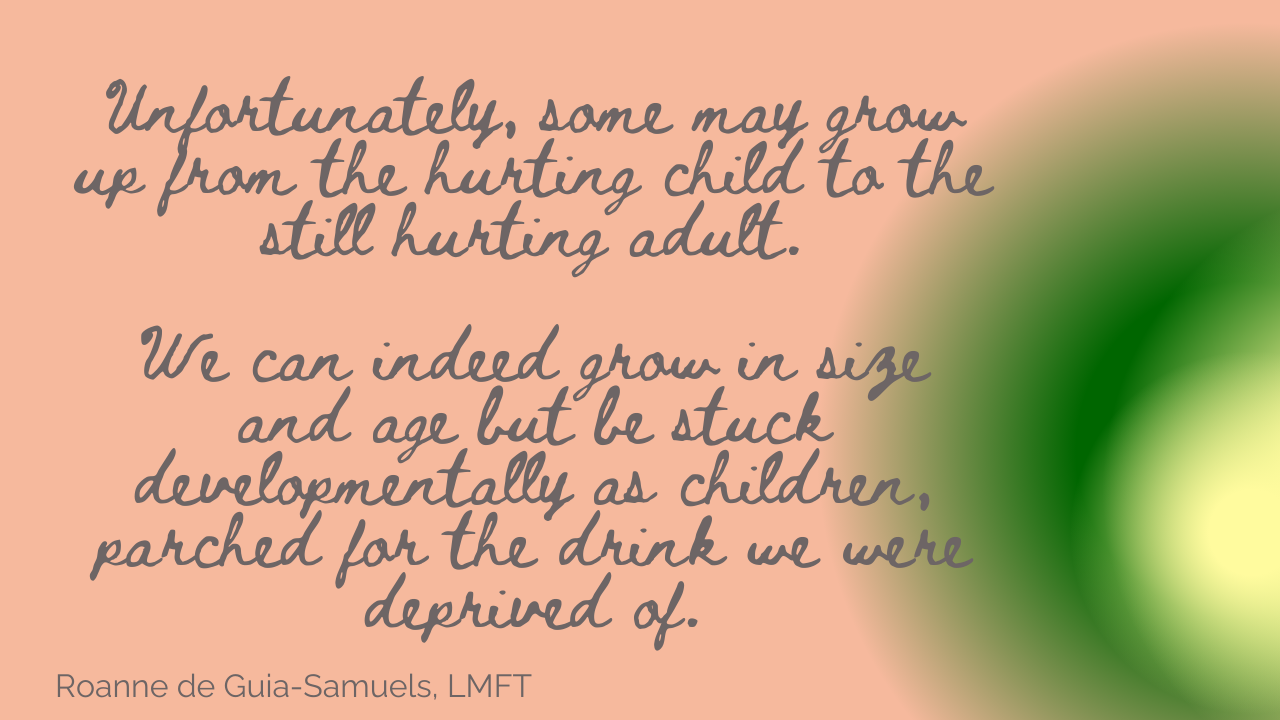
Unfortunately, some may grow up from the hurting child to the still hurting adult. We can indeed grow in size and age but be stuck developmentally as children, parched for the drink we were deprived of.
The relief is that you are now in the position to provide a well of overflowing water to your inner child, but first you must remember where to dig, in the seemingly vast desert of barren dryness.
MORE THAN TALK THERAPY
The western culture prides itself with its linguistic innovations and progress. The invention of the printing press allowed manuscripts to be repeated, circulated, and read widely by a large population. In earlier traditions, ancient cultures rely on oral storytelling in which the story no matter how similar it may appear is never the same. This is because the storyteller is a breathing vessel, he is not the same yesterday and today, and so are his stories.
They are ever changing.
The circulation of media, newspapers and the like allowed the viewers to view one thing, in the same platform, in the same words. Interestingly, the more we aim for fidelity of words and stories- that we stay true to the “original” version, the more we trip on our words. Policing others to the correct format, the right inflection, the appropriate indentation, and indignant to those who walk loosely on that tight rope.
For the hurting child whose words have been repressed, finding a space to hear himself speak and be listened to for the first time is a well-worth start to healing. The witness, be it the therapist or a trusted friend need not trip over the consistency of his words or stories, he is not in a court trial.
Similar to a baby cooing for the first time, any sound is a sound that leads eventually to words and words to stories. An adult Interrupting the coo-ing of a baby, so that the latter can talk properly, isn’t listening well, for communication in words is not the entire story but only a portion of it.
In therapy, you can coo, tell stories, but be understood more than the words you utter. The words and stories you tell yourself are crucial to the type of life you choose to live and yet does not define you.
You can always change your words, the order, the format. You can be inconsistent and not be labeled as a liar (unless you aim to lie). This is the limit of talk therapy, the reliance on the consistency of your story.
Therapy beyond talk therapy integrates both spoken and creative expressions of your being. The therapist is a witness with deep attunement, one who listens to your words and your silence.
All are parts of the ever-changing story that is you.
GIVING VOICE TO TRAUMA
Repressed or hurt parts of yourself can stay in exile according to the Internal Family Systems theory (IFS), in other words, you can put on masks after masks on your real face until you can’t recognize yourself anymore. If you still can, you lose hope that recovering your true self is possible.
Most hurts (not all, one can experience their original trauma event in adulthood) may have been experienced during childhood. Children are vulnerable to the temperament, wimps and value systems of their caregivers. If you get a condescending and abusive pair of caregivers, your true self may have piled up masks and masks for his protection. In adulthood, you may struggle with relationships, setting healthy boundaries, or regulating your emotions.
Trauma or negative imprints are deep pain undigested in your system. If food is stuck in your digestive system, the first step is to simply notice that it is. To ignore or deny its existence does not keep the symptoms of constipation at bay. Instead, the constipation stays put, may get worse, or call out its other symptom friends like the leaky gut symptom to catch your attention. The body can’t be separated from the psyche. The gift of both is it speaks in a language that aims to bring you back to balance, to health, to equilibrium.
All you need to do is to attune to it or if you can’t yet, find a witness that can support you in this process. If you’re interested in this type of healing, you can schedule a complimentary consultation with me here.
Talking about what ails you is only the beginning of your healing. Your stuck parts, masks that you’ve put on for your own protection and survival, are like children with their own personalities. Reasoning with a child that they shouldn’t feel this way, makes them feel “bad,” even though that was a far cry from your intent. Feelings are not facts. Facts are to be reasoned with but when the ailing is from an emotional center, it needs to be validated, felt and witnessed.
Inner child wounds need tender nurturing, a fresh start to a second more joyful childhood. Therapy that includes a variety of creative expression: art, movement, music, sand tray, and many more, retrieves the true self under the masks where no words can.
Learn more about the 5 Day Inner Child Healing Journal Prompts here.
FINAL THOUGHTS
Feelings and emotions are to be felt and sat with rather than reasoned with. The more you reason with a child who is throwing a tantrum, the longer you will have to reckon with it. The sooner you bend down to her eye level and begin to witness her frustration and how it makes sense from her standpoint, even if you don’t agree with it, the sooner the tantrum is over.
Unfortunately, many of us continue to psychologically tantrum about our feelings that were pushed down or was rationalized by an adult as “bad,” or “inappropriate.” The sooner you begin to attune to yourself, the sooner, you set yourself free.
It’s never too late to experience this. You and I are always creating our experience in the present and to transform the past, you can decide to traverse a different path today. If you need my support or curious if we’re a good fit, schedule a complimentary consult here.
The post Inner Child Wounds: When Pain Isn’t Fluent In Words appeared first on My Blog.